
Battle Creek, MI · Garage Door Service
Why a Door Goes Off Track in Battle Creek
Battle Creek's 1960s-70s housing stock and cold winters push garage door tracks out of alignment. Here's what to check first and why it happens here.
- Repairs & new doors
- Springs & openers
- Serving 7 nearby communities
What to Look At First
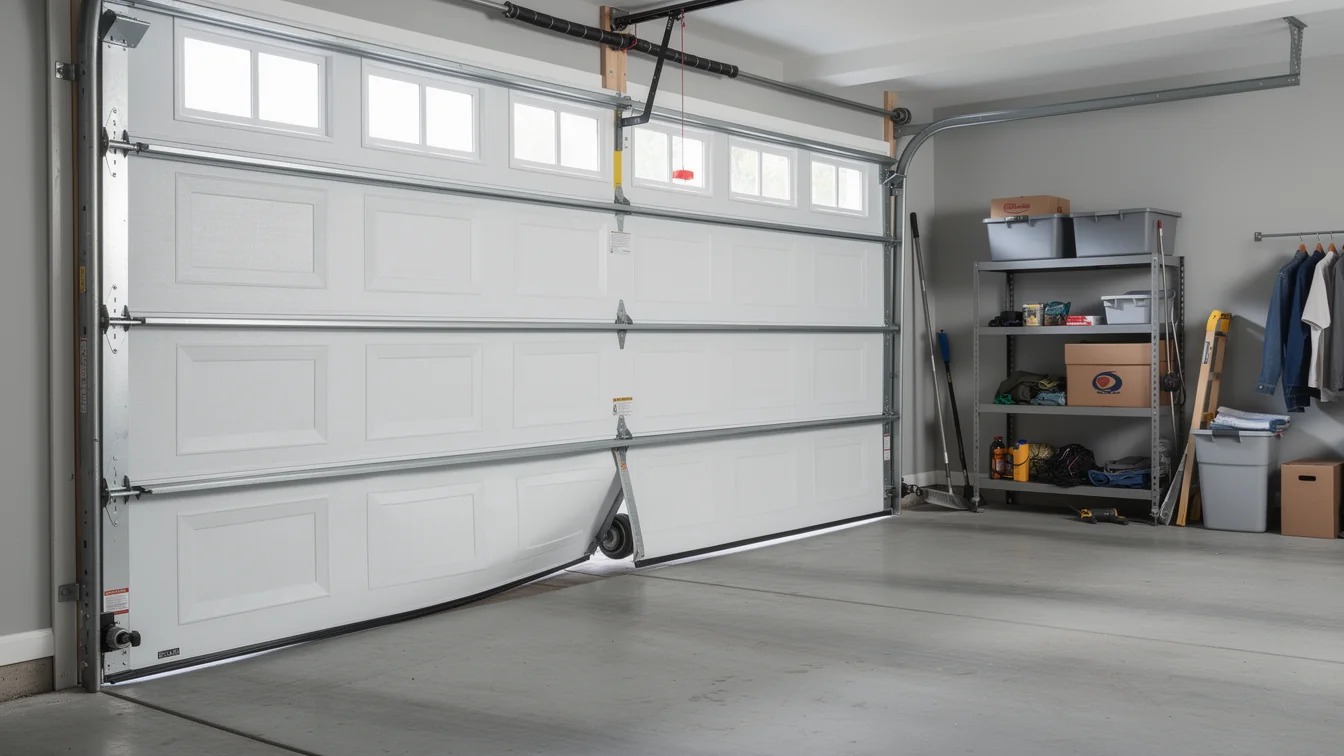
Start at the rollers, not the track. On a door that's jumped its rail, the track itself is almost never the root cause - it's usually a bent bracket, a roller that's worn down to the stem, or a cable that's gone slack on one side. Pull the release and walk the door up and down by hand. If it binds at the same spot every time, that's where a bracket has shifted. If it swings loose and uneven, suspect the cables.
In the housing stock around Battle Creek, most of it built between 1945 and 1993 with a lot concentrated in the 1960s and 70s, the original track hardware on a lot of these doors has never been replaced. Steel brackets from that era are lighter gauge than what gets installed today, and fifty-plus years of seasonal expansion and contraction loosens the lag screws holding them to the jamb. That's the first thing we check on an off-track call in this area, and it's right more often than not.
Check the horizontal track too, where it meets the vertical section near the top of the door. A sag or gap there, even an eighth of an inch, is enough to let a roller walk out of the channel under spring tension.
What Is Going On
A door comes off track for one of three reasons: something broke, something bent, or something froze. Broken usually means a cable or a roller. Bent usually means a track bracket took a hit - a car bumper, a kid's bike, a basketball - and nudged the rail out of parallel. Frozen means ice has built up between the bottom panel and the slab, and the door tried to keep moving after the panel stopped.
That third cause is common in a climate band like this one. Battle Creek sits in a cold-severe zone, and a door that's iced to the floor on a January morning, then forced by an opener that doesn't know it's stuck, will twist the bottom roller right out of its track. We see this most on doors without a working safety reversal or with a worn bottom seal that lets meltwater pool and refreeze overnight.
On older installs - and given the age of housing stock here, that's a lot of doors - the opener itself may predate modern force-limit sensors entirely, which means it keeps pulling even when it shouldn't.
What Local Conditions Do
Cold-severe winters do two things to a garage door track system that milder climates don't. First, the metal itself contracts. A track bolted tight in August can develop a few thousandths of play by February, and that play is enough for a roller to ride up the lip instead of staying seated. Second, moisture cycles in and out of the slab under the door dozens of times a season, and that movement works lag bolts loose in the jamb framing - especially jambs that are now fifty-plus years old on houses built in the 1960s and 70s.
We also see a seasonal pattern tied to attached garages that aren't insulated, which describes a good share of the older housing stock in this area. Temperature swings inside an unheated garage are sharper than outside, so the metal moves more, not less. A track that's marginal in October can be the one that drops a roller in January.
None of this means every old door is doomed. It means the hardware tolerances that worked fine for forty winters finally run out, usually without warning, right when the first hard freeze hits.
Season by Season
Fall: This is when we'd rather get the call than after the first freeze. Tightening loose brackets and lubricating rollers before cold sets in costs less than an emergency call once ice is in the mix.
Winter: Off-track calls spike here. Ice under the bottom panel, contracted track metal, and openers straining against a stuck door all compound. If your door won't move and you hear the motor working, stop - don't keep hitting the button. That's how a roller gets bent, not just dislodged.
Spring: Thaw cycles loosen what winter tightened. This is when brackets that survived January finally let go, because the bolts have worked themselves a little looser with every freeze-thaw swing.
Summer: The quietest season for this particular problem, which makes it the right time for a real inspection rather than a reactive fix. We'll say plainly that we don't do cosmetic panel dent repair - if a track problem has also bent or creased a panel, that's usually a replacement conversation, not a straightening job.
Frequently asked questions
Why did my garage door suddenly jump off the track?
Most often a bracket holding the horizontal track has loosened or bent, or a roller has worn down enough to slip the channel. In this area, houses built in the 1960s and 70s often still have original track hardware, and decades of cold-weather expansion and contraction work the mounting bolts loose over time.
Can I push a door back onto the track myself?
You can look and diagnose, but we'd rather you not force it back under spring tension. A torsion spring holds real stored energy, and a door that's off track with the spring still loaded can whip a bracket or cable loose further. Release the opener, leave the door where it sits, and call.
Does cold weather really cause this?
Yes, more than most people expect. Battle Creek sits in a cold-severe climate band, and metal track contracts in the cold while ice under the bottom panel can stop the door mid-cycle while the opener keeps pulling. Both put sideways stress on rollers and brackets that summer weather doesn't.
Is an off-track door always a track replacement?
No. Most of the time it's a bent bracket or worn roller, both cheaper fixes than a new track. We check the whole run before replacing anything, because on older hardware common to this area's housing stock, one worn roller is often the only culprit.
Related garage door services in Battle Creek
More garage door guides
Book garage door service in Battle Creek
Call now or request a quote - tell us what the door is doing and where you are.